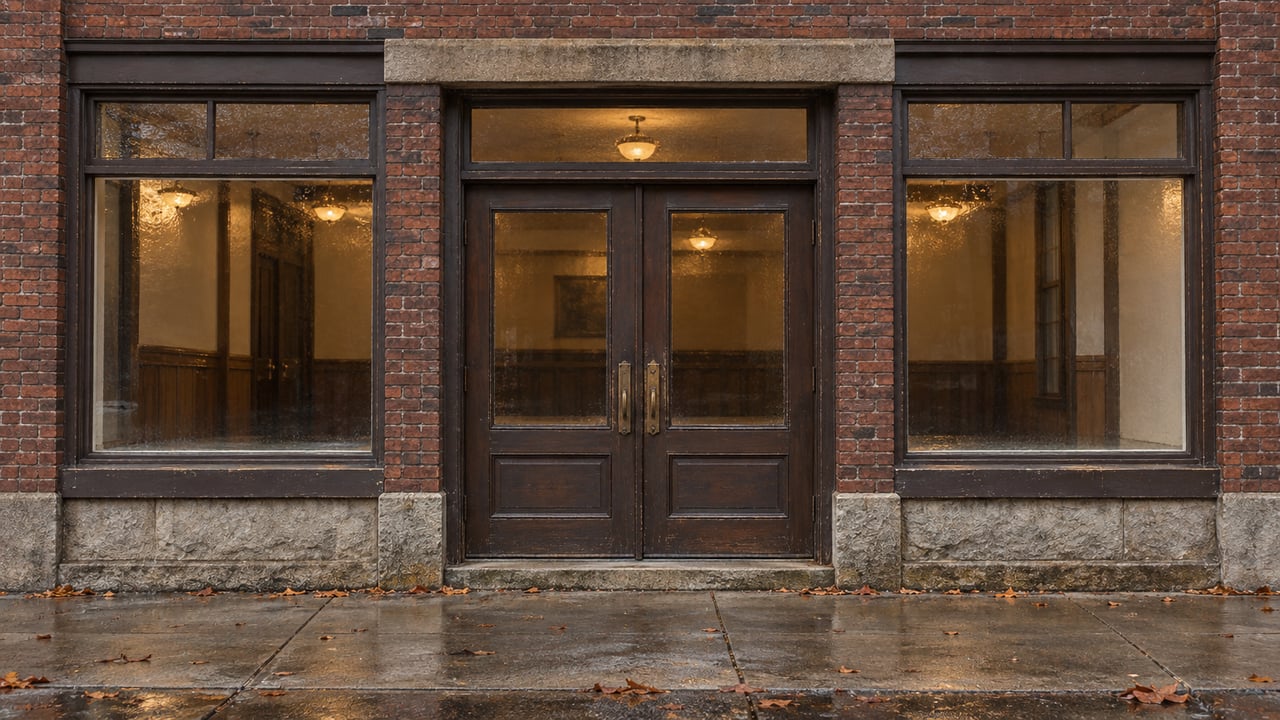
"She was decapitated in the claw-foot bathtub that we still have upstairs," Oxford Saloon owner Brian Swanson has said of Kathleen, the woman most people mean when they talk about the ghosts of downtown Snohomish. The tub is still there. So is the staircase where a policeman named Henry was stabbed trying to break up a card-room fight sometime in the late 1920s. So is the closet where a young woman named Amelia was found dead, her death as unresolved now as it was then.
Ask anyone compiling a Snohomish ghost story and the Oxford comes up first, then the Marks Building a few doors down, then, quieter but still present on nearly every list, the old Carnegie Library. Three buildings, repeated across a decade of local write-ups, television segments, and paranormal society reports. What almost never comes up is the reason those three keep winning: they are not the town's oldest structures by accident. They are the ones that survived the year Snohomish nearly lost its downtown altogether, and there is a fourth site tied to just as much history that has no building left to haunt at all.
The Building Behind The Quote
The Oxford Saloon started in 1890 as a general store built by Arthur M. Blackman, a member of one of the founding families whose name still marks Blackman House Museum a few blocks away. Blackman arrived in Snohomish on Christmas Day, 1885, and had his own storefront open within two years. The building he put up became a saloon in 1910, then a pool room during Prohibition, then a tavern through World War II, changing use several times but never sitting empty long enough to lose its name.
That century of continuous occupancy is what gives the Oxford three named ghosts instead of one vague feeling. Kathleen ran the brothel that operated on the second floor. Amelia worked for her. Henry moonlighted as bouncer on nights when the card games in the basement got out of hand. The Washington State Ghost Society began formal investigations there in 2005, and the building drew a national television crew for an episode of Ghost Adventures in 2015. None of that happened because the Oxford is unusually old for Snohomish. Several buildings on First Street are close to it in age. It happened because the Oxford is one of the few that has been in constant, recorded use since before the town's defining disaster.
A Town That Rebuilt Itself Twice
In 1911, a fire tore through much of downtown Snohomish. What was left standing afterward is largely what still lines First Street today, buildings that predate the fire and were spared by it rather than replacements built after. The Oxford, built in 1890, is one of those survivors. So is the Marks Building, built three years earlier still, in 1887.
That distinction matters more than it sounds like it should. A building erected after 1911 has roughly a century of history to draw stories from. A building that made it through the fire has a longer, messier record: uses that predate the disaster, uses that came after it, and enough turnover in between to accumulate the specific, often violent incidents that get retold as ghost stories rather than dismissed as rumor. The hauntings people repeat about downtown Snohomish are not spread evenly across old buildings in general. They cluster on the handful that were already standing when the town had to start over.
The Jail Under The Boutiques
The Marks Building is the clearest example of what that longer record produces. Built in 1887 as a dry goods store, it later housed the county jail, connected by a tunnel to a police station that once stood across First Street. Cozy shops and boutiques occupy the space now, but reports of moans and jangling keys near the old cells persist, along with accounts of the building's elevator moving between floors with no one operating it.
Every Halloween, the Marks Building leans into that history rather than away from it. The First Street Haunted House takes over the building each year, with admission historically set at one dollar or a food donation. It is a few steps from where the county's prisoners were once held, in a building whose retail storefront gives no hint of what sat above and below it for decades.
The Cemetery No Ghost Map Mentions
The one site with a history as documented as the Oxford's or the Marks Building's, but that almost never appears alongside them, is not a building at all. In 1876, a bluff overlooking the Pilchuck River became Snohomish County's first cemetery, used by Coast Salish families and by the American settlers who came after. Within a few generations, the burial ground was abandoned. Its records were lost. The graves were eventually bulldozed and built over, and the site became, in time, a parking lot. A descendant searching for ancestors found pavement where a grave should have been.
Local historian Taylor Russell built her Lost Cemetery Tour around that discovery, and it is the newest addition to the Snohomish Walks lineup, timed for the season when people are already looking for a reason to walk downtown after dark. The cemetery's absence from most ghost roundups has little to do with how much history it holds. There is no storefront to photograph and no bar to sit in while someone tells you what happened upstairs. The Oxford and the Marks Building get repeated because they are still standing and still open for business. The first burial ground, where Coast Salish families and early settlers were laid to rest, is remembered through the research of local historians and the descendants who went looking for it.
Where To See It Yourself This Fall
Taylor Russell leads Snohomish Walks in partnership with the Historic Downtown Snohomish Association, with public tours on the second Saturday of each month, starting at Cady Park, priced at twenty dollars a person for a route that covers about a mile in seventy-five to ninety minutes. Alongside the Lost Cemetery Tour, she also publishes a downloadable self-guided route built around the town's ghost stories, plus seasonal guided walks covering the town's historic homes, its high school alumni, and the women who shaped it.
The calendar gets busier as October closes out. The Historic Downtown Snohomish Association's own 2026 calendar has First Street Trick-or-Treat confirmed for Saturday, October 31. The same stretch of blocks has, in recent years, filled in around that date with its own set of seasonal traditions:
- First Street Trick-or-Treat, Saturday, October 31, at participating First Street businesses, per the Association's 2026 calendar
- Carving Party and Pumpkin Glow, a late-October gathering at 1112 First St., with jack-o'-lanterns displayed on Avenue A and judged the same evening
- First Street Haunted House, held inside the Marks Building at 1024 First St. on Halloween afternoon
- Ghosts of Snohomish walking tour, a guided walk meeting at 1020 First St. and focused specifically on locations tied to reported sightings
Worth confirming exact times with organizers as the date gets closer, but none of it requires much advance planning beyond picking an evening. The buildings are open for business either way. What changes in October is that the people running them are finally willing to talk about who else might still be inside.
Downtown Snohomish's oldest buildings hold their stories the same way they hold their brickwork, as something original to the structure rather than added for effect. If you own one of those buildings, or a historic Snohomish home with a comparable story sitting quietly in its own walls, Kathie Salvadalena has spent nearly two decades learning how to research, document, and present exactly that kind of history to the next owner. A free consultation is the easiest way to find out what your address has been keeping to itself.