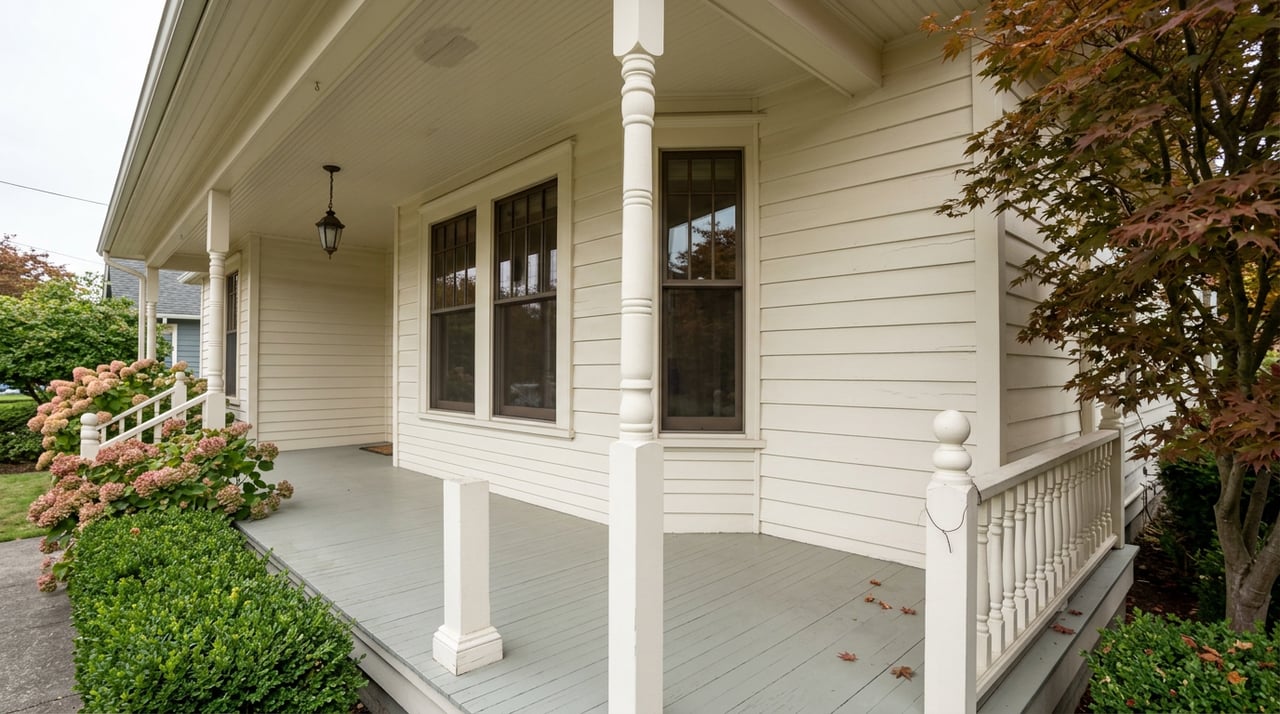
If your listing photos show a freshly painted porch rail or a new picket fence, did that work clear the city's Design Review Board first? For most Snohomish County sellers, that question never comes up. For a seller inside Snohomish's Historic District, it can decide whether a routine sale stays routine.
Most people assume the opposite of what's true here. They think a home old enough to carry a "historic" label must be wrapped in red tape, and a home without a plaque on the porch is free and clear. Neither assumption holds. The plaque, or lack of one, tells you almost nothing about what you can and cannot do to your house. The real dividing line is a set of seven street names most sellers have never heard of, and a single city board that meets once a month.
Two registers, one very different set of rules
Snohomish's downtown carries historic status on three separate registers, and only one of them has teeth.
The National Register of Historic Places recognized the district on November 13, 1974, and the state placed it on the Washington Heritage Register the same year. Listing on either is an honor, not a restriction. Snohomish County's own preservation program describes county register listing the same way: it's used "to honor not regulate a property." Unless federal funding touches the project, a National Register listing places no legal limit on what an owner can build, paint, or tear down.
The City of Snohomish's local Historic District is a different animal entirely. Established by City Council ordinance on July 3, 1973, it exists, in the ordinance's own words, so "a reasonable degree of control may be exercised over the site development and architecture" of buildings within it. That control runs through the city's Design Review Board, and it applies to any exterior alteration, new construction, signage, or fence work on a property inside the mapped boundary.
Here's the comparison sellers actually need:
| National / State Register | City of Snohomish Historic District | |
|---|---|---|
| What it is | Honorary recognition | Local zoning-style overlay |
| Owner consent to list | Required | Established by 1973 ordinance, applies automatically inside the boundary |
| Restricts exterior changes | No, unless federal funds are involved | Yes, through mandatory Design Review Board approval |
| Cost to seller | None | No fee, but added submittal materials (elevations, material specs, sometimes renderings) |
| Who administers it | National Park Service / Washington DAHP | City of Snohomish Design Review Board |
A home can sit on the National Register and still require zero city sign-off for a new coat of paint, as long as that home is outside the local district boundary. A home inside the boundary needs Design Review Board approval for that same paint job, register listing or not. Confusing the two is where sellers get caught off guard mid-transaction.
Where the boundary actually runs
The Historic District isn't "downtown" in the loose, everybody-knows-it-when-they-see-it sense. It has a mapped edge: the Snohomish River, Avenue E and its alley, Avenue D, Fifth Street, Union Avenue, Pearl Street, and Willow Avenue. Homes and commercial buildings inside that footprint fall under Design Review Board authority. Homes a block outside it, even ones built in the same decade with the same Craftsman or Queen Anne details, generally don't.
This matters at the listing stage for a practical reason: two houses built in 1910, three blocks apart, can carry completely different disclosure and renovation obligations depending on which side of Avenue D they sit on. Before pricing a pre-listing improvement or promising a buyer they can add a dormer after closing, the boundary is the first thing to check, not the plaque.
What the Design Review Board actually reviews
Inside the district, the Design Review Board meets monthly and reviews projects in two tiers. Minor items, like a sign or a fence, can be signed off by a single board member. Larger projects go to the full board at a public meeting. There's no additional fee for this review, but the city does require extra material at submittal: detailed elevations, identified materials, and in some cases color renderings or manufacturer specifications.
This is the part that catches sellers preparing a home for market. Fresh exterior paint, a repaired porch, new siding, even a new fence around the yard, are all exactly the kind of pre-listing curb appeal work that staging-minded sellers reach for first. Inside the Historic District, any of that work is supposed to go through design review before a building permit issues. Outside it, in most of the city, that same work is reviewed administratively by staff with no board meeting required at all.
The gap between "I repainted the porch" and "I got a Certificate of Appropriateness for the porch" is where things get complicated. If a certificate was issued and the project didn't match it, or if the work never went through review at all, the county's own code allows the commission to pull that property off the local register entirely, which removes the very protections and incentives, like historic rehabilitation tax valuation, that made the designation worth having.
The disclosure question sellers should ask themselves first
Before listing a home inside the boundary, it's worth pulling together three things:
- Any Certificates of Appropriateness issued for past exterior work, along with the approved elevations or material specs that came with them
- Building permits tied to those approvals, confirming the work was inspected and closed out, not just approved on paper
- A plain answer to whether any exterior change, roof, siding, windows, fencing, was made without going through the Design Review Board
None of this is about creating anxiety. It's about knowing, before a buyer's agent or inspector asks, whether the home's exterior history is clean. A seller who can hand over approved elevations and closed permits is offering real proof of stewardship. A seller who can't is better off finding that out now than during a ten-day inspection window.
A state law that just changed who can be designated next
Here's the piece of this that almost nobody selling in downtown Snohomish has caught yet. In 2025, the Washington legislature passed a new law, now codified as RCW 35.21.995, that stops cities from designating a property as a historic landmark without the owner's consent, specifically when that designation would restrict use, alteration, or demolition. Cities had until July 27, 2026 to bring their local ordinances into compliance, and that deadline has now passed.
The law carves out an exemption for properties already inside a historic district established through a local preservation ordinance, which describes Snohomish's downtown district exactly as it exists today. So homes already inside those seven boundary streets didn't gain new consent rights they didn't already have under the existing 1973 framework.
The people this actually changed are owners of older homes just outside the mapped boundary, the ones old enough to qualify for individual landmark status but sitting on the wrong side of Avenue D or Fifth Street. Under the old rules, a neighbor or a preservation group could nominate that property for designation without the owner's sign-off. Now that the compliance deadline has passed, any new nomination needs the owner's consent first. If you own a century-old farmhouse near, but not inside, the historic core, that's a protection worth knowing you already have.
Frequently asked questions
Does National Register listing restrict what I can do to my home? No, not on its own. Restrictions come from the City of Snohomish's local Historic District designation, which triggers Design Review Board review for exterior work. National and state register listing is honorary unless federal funding is involved.
What kind of projects need Design Review Board approval? Any exterior alteration, new construction, signage, or fence work on a property inside the mapped Historic District boundary. Minor items can be approved by one board member. Larger projects go to the full board at a public meeting.
Is there a fee for design review? No additional fee, but the city requires more detailed submittal materials than a standard permit application, typically elevations with materials identified, and sometimes renderings or manufacturer specs.
What happens if past exterior work never went through review? The Historic Preservation Commission has the authority to remove a property from the local register if unauthorized alteration is found, which also removes the tax and preservation benefits tied to that listing. It's worth resolving before a home goes on the market, not after an inspection flags it.
The takeaway for sellers
A home's historic status isn't one fact, it's at least three, and they don't all carry the same weight. Knowing which register your home sits on, whether it falls inside the seven-street boundary, and whether your exterior work has the paperwork to match, is the difference between a smooth escrow and a surprise a week before closing.
This is exactly the kind of groundwork that shapes a staging plan before a home ever hits the market. If you're weighing a sale of a historic property in downtown Snohomish and want a clear read on what your specific address requires, Kathie Salvadalena offers a free seller consultation and home valuation to walk through it with you, register history, design review, and all.