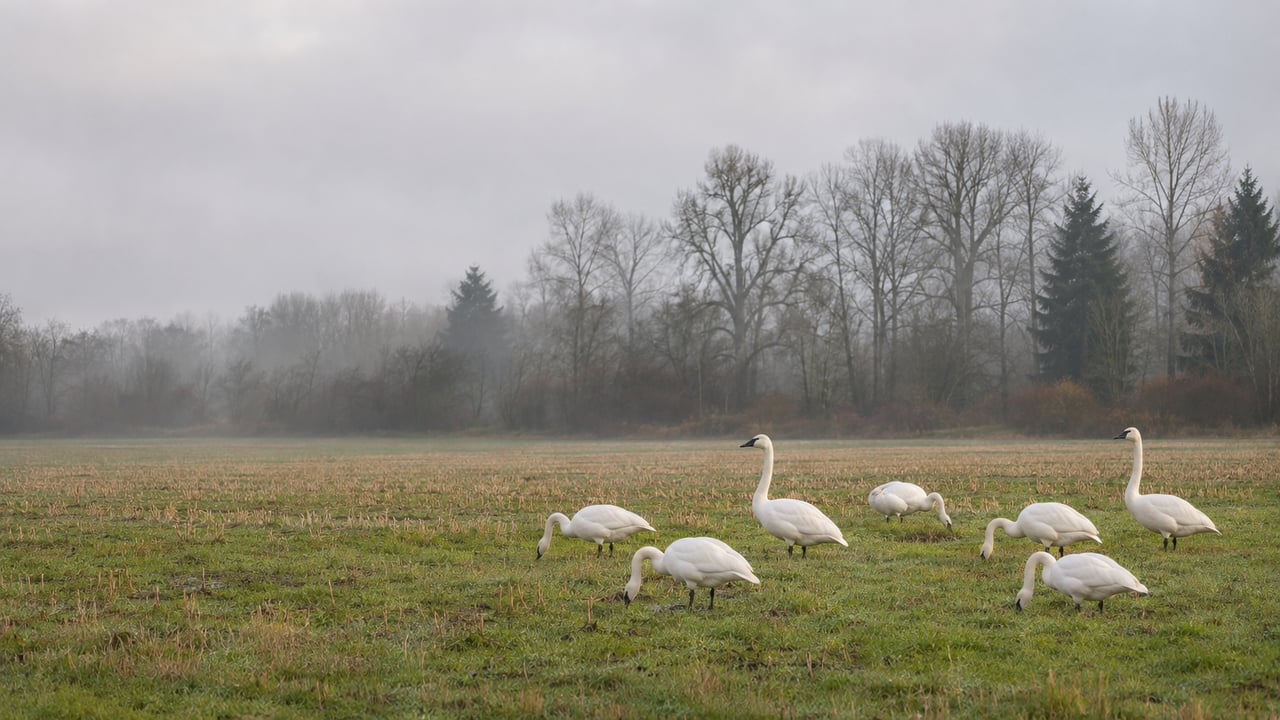
You usually hear a flock of trumpeter swans before you see one taking off. In a 2022 story on the valley's wintering swans, The Daily Herald said to listen for the slap of their feet on the water as they run to get airborne. It said their wingbeats are heavy enough to sound like a heartbeat, and a large group on the ground sounds like a middle school band warming up its brass section. These birds are big. The same story put adult trumpeters at up to 35 pounds with wingspans of up to nine feet.
For years, the best place near town to see them was Shadow Lake at Bob Heirman Wildlife Park at Thomas' Eddy. The Northwest Swan Conservation Association calls it a major night roost for trumpeter swans and a few tundra swans, busiest from late November through December. It says the best viewing is about an hour before sunset and again early in the morning, when hundreds of swans fly in and out. That's right now on the calendar. This winter, though, the park is closed.
Shadow Lake is behind a construction fence
Snohomish County fully closed Bob Heirman Wildlife Park on May 1, 2026, when major construction started on the Thomas' Eddy Restoration Project. The county expects the park to stay closed until construction wraps up in late 2026, and it notes that replanting may continue into the winter of 2027. The county's park closures list, updated November 12, still shows Thomas' Eddy as an ongoing closure. Check that list before you drive out.
The project itself is good news for the valley. The Snohomish County Tribune reported in June that crews are removing a failing levee built in the early 1900s, which has kept the Snohomish River away from that land for more than a century. They are also adding log jams for juvenile salmon, building new trails and replanting the ground. The work is meant to help all five Puget Sound salmon species, especially threatened Chinook, and it is funded in part by $5.85 million the National Fish and Wildlife Foundation awarded the county in 2022. The Tribune's photo of the levee removal shows Shadow Lake in the background. County project specialist Mike Rustay told the paper the reopened park will be "a totally different place" that "looks way more natural than it did before."
So you can't hike the three-mile loop past Robins Pond to Shadow Lake this year, and you can't climb Lord Hill for a view down on the roost either. The swans still have to eat, though.
By day, the swans are in the fields along the drive
The roost is only where swans spend the night. A 2016 Herald piece on swans returning to Snohomish County fields described the daily routine: many birds sleep on Puget Sound, a river or a lake, then fly at daybreak to farm fields around Stanwood, Silvana and Arlington, or around Snohomish and Monroe. The Washington Department of Fish and Wildlife says wintering swans now eat a lot of grass and leftover crops like corn and potatoes on top of their natural diet of water plants. The 2022 Herald story said corn stubble and dairy farms are what draw them here.
Look at the route to the closed park. The Herald's 2016 directions from Snohomish take Highway 9 south about 2.5 miles to Lowell-Larimer Road and Broadway, then east on Broadway to Connelly Road. The 2022 Herald story picked almost the same spot as the place to start a swan search in the Snohomish Valley: Larimers Corner, where Marsh, Lowell Larimer and Seattle Hill roads meet. From there, it suggested heading out along Lowell Larimer or East Lowell Larimer, past the maroon rows of berry fields. The trip you'd have made to Shadow Lake already runs through the valley's swan fields. This winter, you just stop sooner.
Flocks move around over the season, so there's no promise of swans in any one pasture on a given afternoon. If the Larimers Corner fields are empty, the same 2022 story called Crescent Lake near Monroe a sure place to find a bank of swans, and it mentioned fields south of Monroe as well. That February, a single whooper swan turned up in Snohomish County. It's a species that rarely reaches North America, and birders on the roadside said it was only the second ever seen in Washington. People drove hours to see it.
The season is long enough that you don't have to rush. WDFW says about 20,000 trumpeter and tundra swans migrate between November and April, with trumpeters reaching Washington around late October and heading north in April. For the Skagit Valley next door, the swan association lists early November through mid-to-late March as the season and late December through February as the best stretch.
Swan's Trail, the local name for the stretch of valley out past Highway 9 toward the river, is named for a man. According to Good Shepherd Lutheran Church at Swan's Trail, which began in 1908 as a Norwegian congregation, the area is named for Charlie Swan, a local man who cut a trail down to the Snohomish River to pick up supplies.
Watching from the shoulder
On these roads, your car is the bird blind. The 2016 Herald guide says swans are used to vehicles and generally don't feel threatened by them, so stay in or near the car, pull fully off the road and shoot photos through the window. It suggests a bag of dried beans from the grocery store to steady a long lens on the window frame. If you get out, close the door quietly, move slowly, stay out of the farm fields and leave the dog at home or in the car.
These fields are working farms. The swan association notes that dairy farms in western Washington have given swans a big new food source, and also that swans feeding in potato, pasture and cover-crop fields can cause conflicts with farmers. Bring binoculars. A field you can see from the shoulder is a field you don't need to walk into.
The wires over the valley
Watch the valley long enough and you'll notice how many power lines cross it. For a bird that needs a long runway to take off, those lines are a real hazard. Snohomish PUD says trumpeter swans and American crows are the two species most often involved in incidents with its equipment, and it uses line markers to make lines easier for birds to see. The Northwest Swan Conservation Association says the PUD and Puget Sound Energy respond to an average of 200 to 250 bird-related incidents a year. It calls out the PUD's work marking tower-supported transmission lines in the Snohomish Valley with drones, since those lines can't be reached from the ground the way roadside lines can.
The other long-running threat is lead. Swans swallow spent lead shot because they mistake it for the grit they use to digest food, and the association says three pellets are enough to kill a 30-pound trumpeter. In that 2022 Herald story, swan biologist Martha Jordan said swan deaths in western Washington were running at about a tenth of normal that winter. She said she didn't know why and didn't want to celebrate too early. "It's dramatic. It's awful. It's hard," she said of lead poisoning. "And it's preventable."
If you find a dead, sick or injured swan, Skagit Audubon's reporting page lists the WDFW swan hotline at 360-466-0515, which is checked several times a day during the season. You can also reach the Northwest Swan Conservation Association at [email protected] or 206-713-3684. To share a healthy flock you spotted, the association's sighting form asks for the count, date, location and habitat.
Counting them in December and January
If you'd like your swan sightings to go on the record, Pilchuck Audubon runs two Christmas Bird Counts in the county this season. The Edmonds count is Saturday, December 19, 2026, and the Everett/Marysville count is Saturday, January 2, 2027. Both are listed on the society's Christmas Bird Count page with sign-up details. Last season's Edmonds count, held December 20, 2025, recorded 77 trumpeter swans. The Everett-area count covered in the 2022 Herald story tallied 76 trumpeters and just four tundra swans in its 24-hour count. Those single-day counts cover a few circles, not every field in the county. They do show how much more common trumpeters are than tundra swans here.
Later in the season, the Stanwood Area Historical Society holds its Snow Goose Festival on Saturday, February 27, 2027, from 9 a.m. to 4 p.m. at the Floyd Norgaard Cultural Center in Stanwood, with speakers, bus tours and children's activities. Its speaker lineup on the festival page includes "Washington's White Birds of Winter," a talk on swans and snow geese by swan biologist Martha Jordan. Until Thomas' Eddy reopens, start at Larimers Corner and follow Lowell Larimer Road east with the window rolled down, listening for the brass section.
Part of what makes winter here special is a valley full of swans just south of town, and a park being rebuilt so the river can reclaim it. If you're thinking about selling a home this winter and want help showing buyers what everyday life looks like here, Kathie Salvadalena would love to talk it over with you, over coffee or on a drive past Larimers Corner. Request a free seller consultation and home valuation whenever you're ready.